
Lower Manhattan
September 1, 2019
When it comes to transit in the United States, there’s New York City, and then there’s everything else. Much of this can be attributed to the low car ownership rate and high public transportation usage within the city. New York is the only city in the United States where more than half of all households do not own a car. In Manhattan, approximately three out of every four households does not own a car. Meanwhile, only 8 percent of households in the entire country are car-free. As of 2006, about two-thirds of city residents used public transit to commute to work.
Most transit in New York is operated by the Metropolitan Transportation Authority (MTA), a state agency that manages mass transportation policy for the entire New York City metropolitan area (the five boroughs of New York City plus Dutchess, Nassau, Orange, Putnam, Rockland, Suffolk, and Westchester counties). The MTA was founded in May of 1965 as a state agency in order to take over the operations of the LIRR. It would later assume operational responsibility for what is now Metro-North, the New York City Transit Authority, and the Triborough Bridge and Tunnel Authority. Today, the MTA operates 25 subway routes, the Staten Island Railway, 325 bus routes, 5 Metro-North routes, and 11 LIRR routes using a fleet of nearly 6,500 subway cars, over 5,700 buses, and nearly 2,500 commuter rail coaches. In some instances, a single New York City Subway yard is responsible for servicing and dispatching as many cars as entire subway systems elsewhere in North America have on their entire roster. Over 8 million people use MTA services on a daily basis.
Although the New York City Subway is not the oldest in the United States (that title goes to the Green Line in Boston), it is by far the largest in the United States in terms of the number of stations and daily ridership. It is also notable for having express tracks for much of its length (the Broad Street Line in Philadelphia and the North Side Main Line on the Chicago L are the only other subways in the United States to have express tracks) and for operating 24 hours a day (PATH and PATCO in New Jersey, the Red and Blue lines in Chicago, and the Green Line in Minneapolis-St. Paul are the only other 24/7 rail operations in the United States).
Other regional transit operations include PATH, a train operated by the Port Authority of New York and New Jersey connecting New York City with Jersey City, Hoboken, and Newark, Nassau Inter-County Express (NICE) buses on Long Island (formerly MTA Long Island Bus), the Roosevelt Island Tramway, and Bee-Line Bus System in Westchester County. Many New Jersey Transit rail services terminate at Penn Station in Midtown Manhattan, while New Jersey Transit bus services terminate at the Port Authority Bus Terminal and the George Washington Bridge Bus Terminal. Penn Station is the busiest train station in the United States and the Port Authority Bus Terminal is the busiest bus station in the United States.
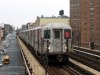
The New York City Subway has an active fleet of over 6,400 cars as of November 2016. Most of the active fleet was built by either Alstom, Bombardier, or Kawasaki. Due to the narrower profile of the A Division (IRT or numbered lines), subway cars are either designed to operate on the A Division or B Division (BMT/IND or lettered lines). Since the introduction of the "New Technology Trains", the average straphanger probably sees even less of a difference between the car types than previously, as the active fleet is no longer as diverse or varied as it used to be.
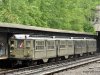
On account of its age and a longstanding effort to retain retired stock for historical purposes, many vintage subway cars spanning nearly the entire history of the New York City Subway have been preserved. While some of these cars are located at various museums, most of them are at the New York Transit Museum. In turn, many of these cars can be used on "fantrips" or for other special occasions. Since the mid-2000s, a train of vintage cars has been operated on Sundays between Thanksgiving and Christmas as well.
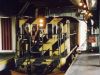
A number of specialized equipment types have been ordered by New York City Transit in order to maintain the subway system. Work equipment includes diesel locomotives, vacuum trains, pump cars, track geometry inspection vehicles, snowblowers, and refuse motors.
29 Photos
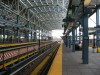
The New York City Subway has more stations than any other subway in the world. Officially, the MTA counts 472 stations as of January 2017, but when counting "station complexes" as a single station, that number decreases to 424 (though still the most stations in a single system by far). Of these stations, 275 are fully underground, 153 are elevated, 29 are on an embankment, and 15 are in an open-cut. From the subway's opening in 1904, mosaics and other artwork has been incorporated in to station designs. Since 1985, the MTA Arts & Design program has installed artwork at more than 260 stations. The New York City Subway also features a number of abandoned stations and platforms that are no longer in use, many of which can be seen from passing trains or other publicly accessible areas.
157 Photos
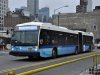
MTA Regional Bus Operations operates the largest bus fleet in the United States, with 5,725 buses serving 234 local routes, 71 express bus routes, and 20 Select Bus Service routes as of early 2020. These buses serve all five boroughs and many routes operate 24 hours a day. Most bus routes are part of MTA New York City Bus, while the others are part of MTA Bus and were formerly operated by private companies under the administration of NYCDOT.
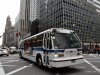
Although it is not as large as the retired subway fleet and it does not make as many appearances, the MTA has preserved a number of vintage buses for historical purposes. These buses are most frequently displayed at BusFest each year at the New York Transit Museum. They have also occasionally operated in revenue service during the Christmas shopping season each winter.
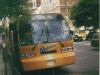
The MTA has repurposed several retired buses to operate as mobile Metrocard salespoints. These buses make scheduled stops for several hours at locations throughout New York City, enabling those who cannot easily access a subway station the opportunity to purchase a new card, refill a card, or apply for a reduced fare card at their convenience.
2 Photos
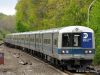
The Metro-North Railroad serves the northern suburbs of New York City in the Hudson Valley as well as southwestern Connecticut. Metro-North's predecessor railroads date back to 1832. Today, Metro-North operates a total of five lines. Three lines operate east of the Hudson River and terminate at Grand Central Station in Manhattan. Two lines operate west of the Hudson River and terminate at Hoboken Terminal in Hoboken, NJ; these lines are operated by New Jersey Transit under contract to Metro-North.
20 Photos
The Long Island Railroad (LIRR) is the busiest commuter railroad in North America one of the oldest continuously operating railroads, having been established in 1834. Today, the LIRR serves 124 stations and over 700 miles (1,100 kilometers) of track.
21 Photos
Nassau Inter-County Express (NICE) is the Nassau County funded bus system serving eastern Long Island. Since 2012, the system has been operated by Transdev (formerly Veolia) under contract to Nassau County. Prior to that time, the system was known as MTA Long Island Bus and was operated by the MTA. This arrangement was terminated due to disputes over the size of the subsidy MTA provided to operate the service. MTA's operation of Long Island Bus dated back to 1973, when the MTA began acquiring the private companies that had operated bus service in Nassau County before that time. As of early 2020, NICE operates 38 routes using 280 buses.
2 Photos
PATH is a wholly owned subsidiary of the Port Authority of New York and New Jersey, connecting Newark, Hoboken, Jersey City, and Manhattan. The system was originally built by and operated the Hudson & Manhattan Railroad (H&M) starting in 1908. When the H&M declared bankruptcy in 1962, the Port Authority bought it out of receivership; through this deal the Port Authority was able to construct the original World Trade Center. PATH replaced all of its older rolling stock with new PA-5 railcars that were built between 2008 and 2012. Due to being a part of the national railroad system on account of track connections that no longer exist, all of PATH's rolling stock must comply with FRA regulations, even though it appears to just be a conventional heavy rail system.
13 Photos